Sands of Iwo Jima


As classics go, you could do a lot worse than this John Wayne movie, made only four years after the war ended. Wayne — arguably better as a marine sergeant than a cowboy — plays John Stryker, who leads his men into the bloody Battle of Iwo Jima in the Pacific campaign. The battle scenes are pretty sanitized by today’s standards — especially considering how bloody Iwo Jima really was — but it’s old-fashioned manly patriotism at its best.

The Big Red One

Rich, detailed and all-encompassing, this masterpiece follows the 1st US Infantry Division from North Africa to Czechoslovakia. The film is essentially director Samuel Fuller’s telling of his own wartime story, giving The Big Red One a haunting sense of realism, isolation and dislocation. But despite its masterful storytelling, the film was largely overlooked until a 2004 remastering, containing an extra 47 minutes, was released at the Cannes Film Festival, seven years after Fuller’s death.

Catch-22

Along the anti-war lines of Slaughterhouse-5, this is another adaptation that can’t touch the novel (by Joseph Heller) that it’s based on. But it’s definitely worth seeing. Heller’s sardonic humor is very much intact, and the cast — including Alan Arkin, Buck Henry, Jon Voight, Anthony Perkins, Martin Sheen, and Orson Welles — is top notch. Yossarian (Arkin) desperately wants to get out of the war and tries to feign insanity, but since insane people want to fight, by trying to admit he’s insane, it proves he’s not insane. It’s a total catch-22. Oh wait…

A Bridge Too Far

I’m only including one “Bridge” movie on this list, so I figured I’d give A Bridge Too Far the attention instead of the obvious choice of The Bridge on the River Kwai. While the latter has well-deserved status as a classic, A Bridge too Far is also terrific (if long), and boasts an amazing cast of badasses including Sean Connery, James Caan, Robert Redford, Michael Caine, Gene Hackman, Anthony Hopkins, and Laurence Olivier. It was an enormous success in Great Britain when it was released in 1977, but had a disappointing run in the U.S. — probably because, as the title implies, the good guys don’t exactly win the battle, and Vietnam-scarred audiences weren’t in the mood for a downer.

At the Movies: A Veteran’s War

It was a long way from a machinegun mount in a military convoy in Baghdad. Robynn Murray’s getup was very elegant on Sunday at the Academy Awards in Beverly Hills, California. What made her stand out from the famous movie stars at Hollywood’s gala event was the brace of tattooed pistols perched on her chest atop a stunning black and gray dress.

Murray, a former Army sergeant, was there because “Poster Girl,” a documentary about her home front battles as a combat veteran of the war in Iraq, was a contender for the award for short documentaries. Despite its title—with an allusion to the Hollywood pinup girl photos of World War II—“Poster Girl” was one of the few films in the Academy Awards lineup that was very different from typical movie fare. The quick flickering of a few scenes from the film, before the Oscar was—dramatic pause—presented to another short documentary (“Strangers No More”), did not begin to convey how different this film is from standard Hollywood flicks about war as scary entertainment.

As the 38-minute documentary by director Sara Nesson shows, the aftermath of war is sometimes brutal for survivors. This film, a review in the Burlington (Vermont) Free Press noted, profiles “a high school cheerleader and National Merit Scholar from Buffalo who enlisted in the Army Reserve at age 19 to work in a civil affairs capacity. Along with two female colleagues, she posed for the September 2005 cover of Army Magazine — hence the title of Nesson’s film. But beginning in May 2004, the military had Murray wielding a machine gun from the turret of a Humvee that was taking sniper fire. She returned home with wounds and post-traumatic stress disorder.”

The film unflinchingly shows Murray back home in Niagara Falls, NY punching walls, kicking her car door and having a panic attack on camera, amid rambling talk about the times she wanted to commit suicide. Here’s a scene from the movie, as captured by Cythnia Fuchs in a review for PopMatters:

As Robynn recalls entering a home where a family has been shot and killed, she emphasizes the blood on the walls and mattresses. “They got shot in their sleep,” she says, then reflects on her own lack of response at the time: There was this piece of bread,” she recalls, “And there was this piece of brain on it.” Sent to assess the scene, she did just that, until she remembers walking up the stairs and seeing a bloody handprint o the wall. Here Poster Girl shifts time and place, pulling you into Robynn’s sense of lurching up the stairs: her steps are heavy, the camera pitches. The camera arrives in the attic of Robynn’s mother’s home, where Robynn is punching the wall, with boxing gloves. She slams through the surface, then reflects again: “Oh, that’s a problem,” she observes, as she sinks to the floor, beginning to sob. You hear more steps approaching. Her mother, Ann Marie Hacker, comforts her.

Going beyond the usual filmmaker fascination with lives descending into destruction, the documentary also shows her determinedly finding a path to recovery. Rebuffed by the VA, which lost her application for assistance, she found an activist path to another, better stage of life. As the Burlington Free Press noted, “Murray … discovered that her anguish could be ameliorated by making combat paper [artwork from shredded military uniforms]; penning poetry for the Warrior Writers, an initiative that provides opportunities for vets to articulate their experiences; and becoming an activist with Iraq Veterans Against the War, of which she is now a board member.”

Finding a network of assistance for healing from hidden wounds can be hit or miss. Robynn Murray stumbled across a compatible group of veterans and supporters who work together to transform tough times in their lives into artwork, poetry and other forms of creative expression. “Warrior Writers saved my daughter’s life,” her mother said to a circle of audience members at a recent showing of “Poster Girl” in New York City.

Hollywood movie-makers seldom get so close to filmed experiences that come that near to real life saved from the relentless jaws of death.

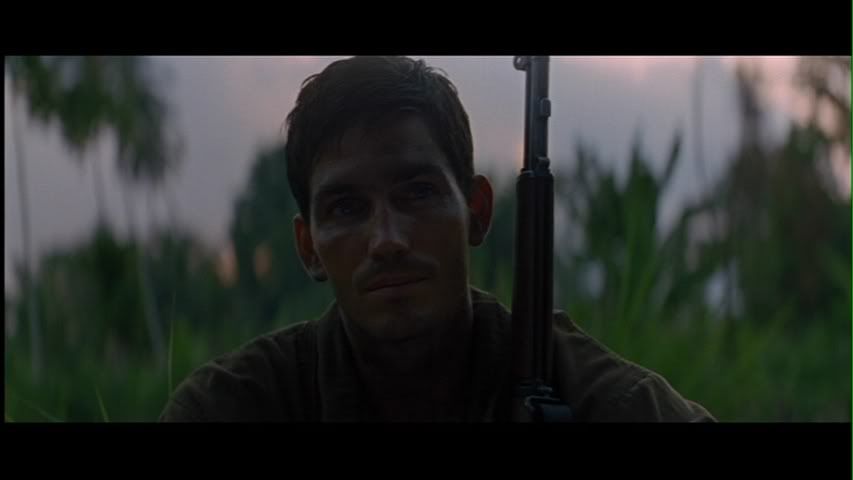
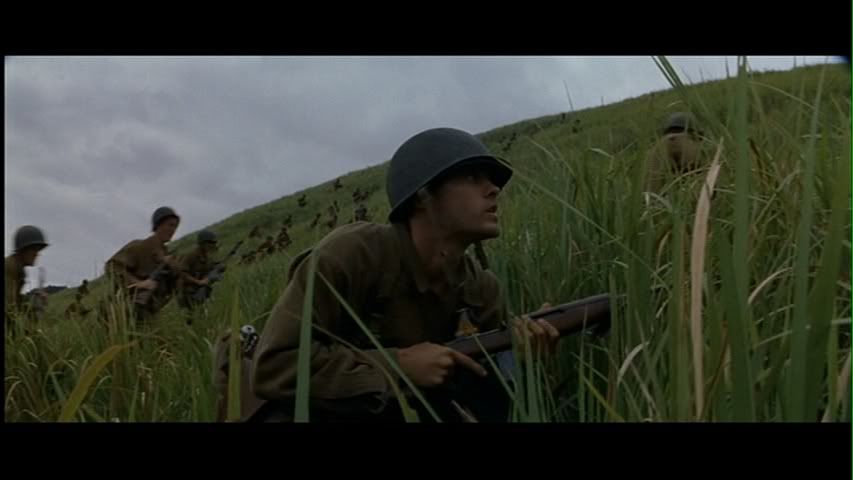
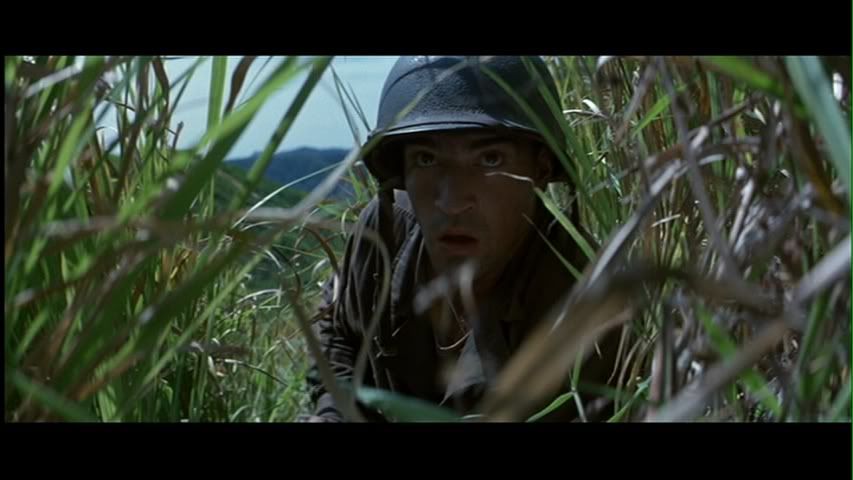
The Thin Red Line (1998)


The website Films of Being likens Terrence Malick to a modern-day American Transcendentalist, in the style of Ralph Waldo Emerson or Henry David Thoreou. There is a good deal of merit to this claim: Malick's films are suffused with lingering shots of nature and meditative voice-overs examining a sort of transcendental, mystical spirituality. Malick himself is also a professional philosopher: with a philosophy degree from Harvard, an unfinished BPhil from Oxford (the university's most notoriously difficult degree course), and teaching experience at MIT. It's exciting, in a way, to have a real, live philosopher making real, live philosophical movies, and it was exciting for us to identify the threads of metaphysics and mysticism in what would otherwise have been a typical World War II movie.
The Thin Red Line, Malick's third film after a 20-year gap, is, in many ways, highly cliched: a World War II movie told from the grunt's point of view, with a large ensemble of celebrities, and numerous scenes of alternating horror and bravery. What sets this film apart is, of course, Malick's magic touch: his style of filmmaking is particular enough that some scenes - such as the initial assault, onto the beach, or up the hill - are genuinely fresh, inventive, exciting and terrifying. Nonetheless we at the PPCC were somewhat disappointed, because even an intelligent director like Malick eventually crumbles under the weight of his film's content. At times, it felt like Yet Another War Movie. Also, we had the added difficulty of recognizing some lines of dialogue from UNKLE's Eye for an Eye and Explosion in the Sky's Have You Passed Through This Night?, hence rendering perhaps one of the film's most effective moments overly familiar and trite. But that was just bad timing on our part.

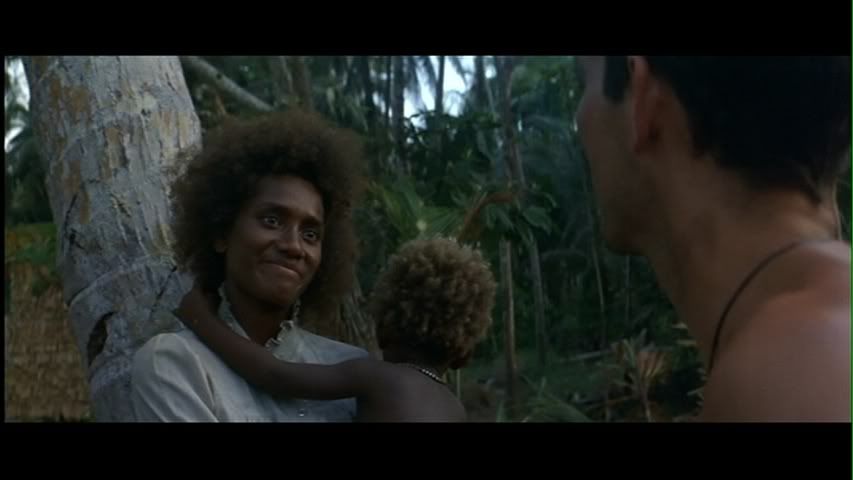
The film opens with an American soldier, Witt (James Caviezel), cavorting among the locals in an idyllic Melanesian paradise. These scenes, similar to Colin Farrell's cavorting in pre-Europeanized America in The New World, are Malick's strength: a highly idealized, intoxicating paradise, peaceful and profound, where men come to escape from the grinding wheels of the Western machine. But Witt is soon forced to leave Eden, when his American sargeant, Welsh (Sean Penn), arrives and drags him back to his old unit, the C Company. Here, the story expands and we are introduced to a number of characters: there is Private Bell (Ben Chaplin), aching to return to his wife (Miranda Otto), there is the captain who is trapped by orders he cannot obey (Elias Koteas), the maniacal and aging Lieutenant Colonel who is desperate for a promotion (Nick Nolte), and so on. What's interesting is how many very familiar faces appear for only a few moments: actors like John C. Reilly, George Clooney, Jared Leto, Woody Harrelson, Adrian Brody and John Travolta appear sometimes for only minutes, for only a line of dialogue. Unfortunately, this superstar-studdedness wearies our suspension of disbelief, turning the battle of Guadalcanal into a cameo-a-thon. At least, our disbelief was really broken when John Cusack arrives to lead a raid on the Japanese bunkers. We just saw him in frickin' Martian Child (avoid, yaar), how can we take him seriously now?!

But that's the genre. Ever since those old school WWII movies like A Bridge Too Far, it seems like these things have to become celebrity clown cars. And Wikipedia says Gary Oldman, Bill Pullman, Viggo Mortensen and Mickey Rourke also acted in the film but had their scenes cut. For the love of God!

Indeed, all the familiar trappings of the genre are here: the horrific death of a comrade, men displaying courage and fear, the high-strung tension and explosive violence. Thankfully, Malick underplays the violence, underscores the men's fear, and generally remains contemplative even in all this chaotic, overly familiar noise. The result is a thinking viewer's war movie, and the best moments are those that present the war indirectly, as a vehicle for philosophical meditations. Witt, who is more or less the protagonist, is presented as almost a Buddha-like figure: enlightened, serene, eternally compassionate. (We can understand why James Caviezel was a shoe-in for The Passion of Christ: he can look so benign and spiritual!) Some critics have noted a quasi-Buddhist theme to the film, but we would argue that it is Christian-centric, just like American transcendentalism always is: at least, Witt uses concepts such as soul, grace and glory. While his fierce compassion and his musings on interdependence are certainly Buddhist-like, his belief that there is a "spark" in everyone and everything, and his faith in a better world out there are much more reminiscent of Judeo-Christian mysticism. "Maybe all men got one big soul everybody's a part of," Witt says at one point, "all faces are the same man." We're convinced, also, that Witt is short for Wittgenstein, one of Malick's favored philosophers.

In fact, we wish we knew more about Wittgenstein, just to pick up on other themes. Witt, for example, is often also associated with death - he acts as stretcher bearer for a time, his voice-overs often focus on death and the death of his mother (told in flashback), and he is shown often as the hand-holder and bedside comforter. He is also associated with birds, both caged and uncaged. We can't make heads or tails of this yet.

The most satisfying moments in the film are also the interactions between transcendentalist, emotionally engaged Witt and Sargeant Welsh, who is instead cynical, numb and unable to "see the spark" in life anymore. When one character dejectedly tells Welsh he doesn't feel anything anymore, Welsh replies: "Sounds like bliss." Yet it is clear that Welsh is drawn to Witt's faith and spiritual idealism, even as he finds himself incapable of feeling it himself. These two characters have a number of fascinating dialogues where they basically circle each other, curious, holding a sort of plain-clothes philosophical debate.


Overall, the film is wonderfully evocative, as much as it is cerebral. Of course, something wouldn't be transcendental if it didn't emotionally engage us! Unfortunately, the film has to tediously tread down several well-worn paths in order to make its philosophical points, but thankfully the ride through even these cliched scenes is well-handled and original. There are some surprises - John Travolta turned his cameo into an amazingly fleshed out character, and likewise for Jared Leto! - and we can't honestly say anything is badly done. At worst, this film is conventional. At best, it is transcendental! Huzzah, mission accomplished!

World War 2 Movies

World War 2 movies was made because of the very destructive world war 2 disaster. Million of lives were lost and thousands upon thousands were missing. People will always remember how innocent lives were taken. How crimes to women were done and how low the value of human lives. Here we present you the list of the greatest movies about World War 2.

1. Schindler's List (1993)
2. Casablanca (1942)
3. Ningen no jôken (I) (1959)
4. Saving Private Ryan (1998)
5. The Pianist (2002)
6. Das Boot (1981)
8. The Bridge on the River Kwai (1957)
9. La vita è bella (1997)
10. Der Untergang (2004)
11. Inglourious Basterds (2009)
12. The Great Escape (1963)
13. Hotaru no haka (1988)
14. Roma, città aperta (1945)
15. Stalag 17 (1953)
16. Idi i smotri (1985)
17. L'armée des ombres (1969)
18. To Be or Not to Be (1942)
19. Au revoir les enfants (1987)
20. Ballada o soldate (1959)
21. Obchod na korze (1965) (Slovakia)
22. A Matter of Life and Death (1946)
23. Patton (1970)
24. Pearl Harbor (2001)
25. Enemy at the Gates (2001)
26. Oorlogswinter (2008)
27. Pearl Harbor (2001)
28. Stalingrad (1993)
29. Valkyrie (2008)
30. The Guns of Navarone (1961)
31. The Battle of Britain (1969)
32. The Best Years of Our Lives (1946)
33. The Longest Day (1962)
34. The Thin Red Line (1998)
35. Victory (1981)
36. Band of Brothers (TV Mini-Series) (2001)
37. The Pacific (TV Mini-Series) (2010)
38. Cross of Iron (1977)
39. Where Eagles Dare (1968)
40. In, Wich We Serve (1942)
41. Come and See (1985)
42. Tora! Tora! Tora! (1970)
43. From Here to Eternity (1953)
44. Ice Cold in Alex (1958)
45. Letters From Iwo Jima (2006)
46. Atonement (2007)
47. Conspiracy (1997)
48. Kelly's heroes (1970)
49. Downfall (2004)
50. Days of Glory (2006)
51. A Bridge Too Far (1977)
52. The Pianist (2002)
53. The Dam Busters (1955)
54. The Cruel Sea (1953)
55. Carve Her Name With Pride (1958)
56. Defiance (2008)
57. Mrs. Miniver (1942)
58. The Dirty Dozen (1967)
59. Reach for The Sky (1956)
60. Enigma (2001)
61. Went the Day Well (fiction) (1942)
62. The Big Red One (1980)
63. The Train (1964)
64. Run Silent, Run Deep (1958)
65. Europa, Europa (1990)
66. The Counterfeiters (2007)
67. Black Book (2006)
68. Battle of the Bulge (The Ardennes) (1965)
69. One of Our Aircraft Is Missing (1942)
70. The Eagle Has Landed (1976)
71. Memphis Belle (1990)
72. Von Ryan's Express (1965)
73. 633 Squadron (1964)
74. Flags of our Fathers (2006)